moneytyping — money journal
🗞 press room → 📖 get the guide (pdf) → jason@moneytyping.app
the manifesto → the moneytyping guide → online handbook →
42 essays → 40 blog posts → why budgeting apps fail → adhd & impulse spending → financial anxiety → zen →
for adhd brains → for freelancers → for college students → for techies → financial anxiety help → paycheck to paycheck → budgeting for beginners →
moneytyping vs ynab → moneytyping vs mint → moneytyping vs notion → vs spreadsheets →
killed my amazon habit → killed my doordash habit → killed subscription creep →
🍎 app store → ▶ google play → sitemap →
not a spreadsheet read the manifesto
moneytyping — the zen terminal for your money

money needs attention.talk to your money.

a 30-second money journal. no bank connection. no categories. no budget. just honest words, typed before the moment disappears.

start moneytyping now! start moneytyping now! wait, what is this? ↓

50 cards free · no bank connection · no signup required

scroll
one question

do you remember what you
spent today?

not approximately. specifically — the transactions, the amounts, the context. go ahead, try.

good. you're already paying attention. moneytyping makes that attention richer — not just amounts, but context, emotion, pattern. the words your bank statement never captures.

type what happened. in 30 seconds. in your own voice. your voice is the data that changes behavior — not the category, not the chart.

that's most people. the large transactions survive. the small, frequent ones — the coffee, the quick delivery, the subscription that renewed — dissolve within hours. digital payments were designed to be forgotten.

moneytyping closes the gap between spending and awareness to 30 seconds. that's the window before the context disappears. type what happened while it's still real.

that's financial amnesia. not a character flaw — a design feature. tap-to-pay, one-click ordering, auto-renewals — the frictionless economy was built to make spending invisible.

moneytyping gives your money a voice. 30 seconds after each transaction. in your own words. no bank connection, no categories, no budget to fail. just the story of what actually happened — before it disappears.

that avoidance is the symptom, not the cause. financial guilt converts to avoidance — and avoidance makes everything worse. the budget app with its red bars and "over budget" alerts made it worse. moneytyping has no budget to fail.

just a text field. just your words. just the honest 30-second account of what happened before you decide whether to judge it. the judgment can come later. the awareness comes first.

writing about moneytyping?

moneytyping is the first personal finance app built on phenomenological principles — treating spending as narrative, not accounting.

📝 read the blog → 📖 get the guide →
jason@moneytyping.app
are you struggling with money?
the problem

too much amazon?
yeah, me too.

they built a trap. see something. tap. it arrives. no pause, no friction, no thought — just an automated dopamine loop that collapses desire into acquisition in under two seconds. the object becomes emotionally vivid. the money spent becomes emotionally invisible.

algorithmic stimulus — a perfectly targeted ad. a recommendation. a late-night browse.
📱 frictionless biometric tap — face id, saved card, one-click. cognitive consciousness wholly bypassed.
📦 instant material manifestation — package arrives. you barely remember ordering it.
😶 delayed post-mortem — bank statement arrives 48 hours later. cold list of numbers. the moment for change has passed.

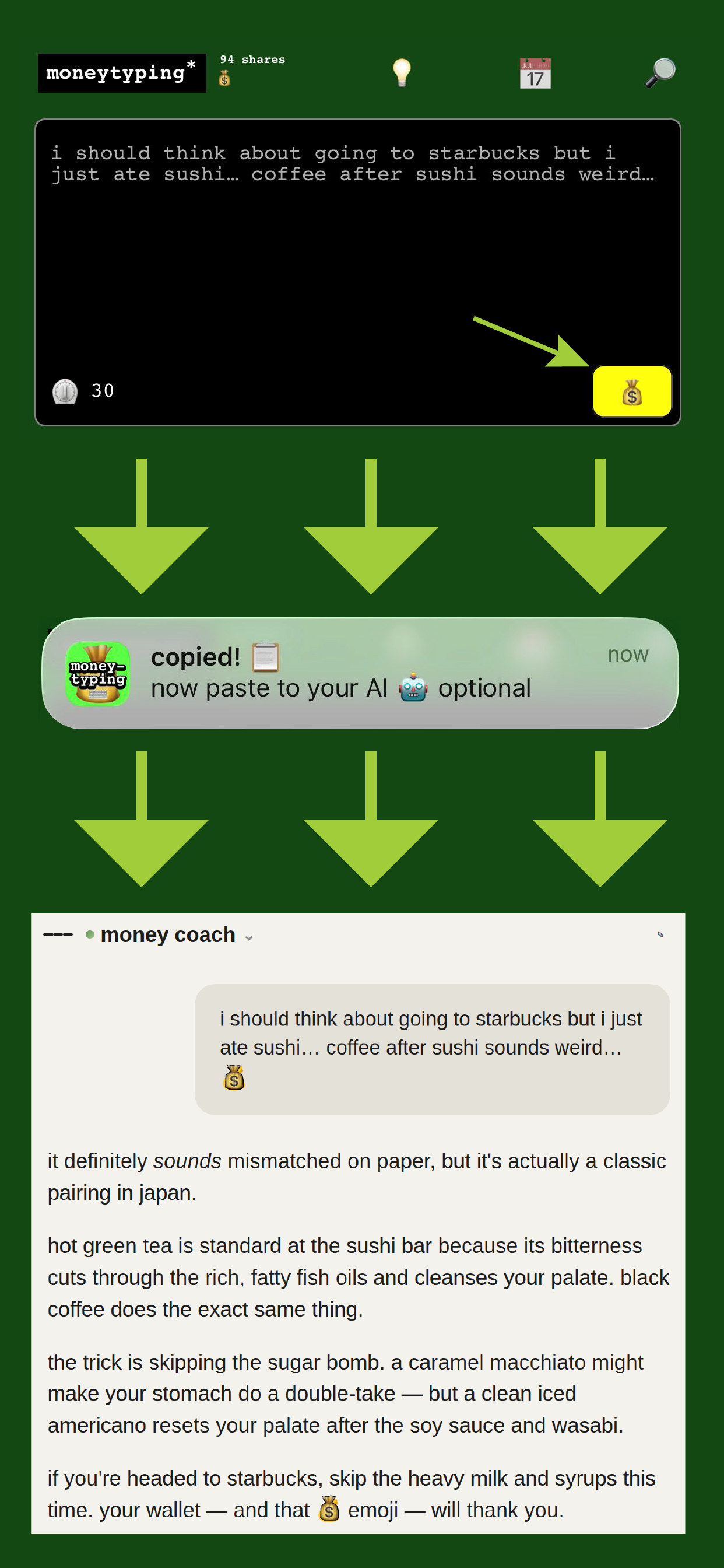
moneytyping is the consciousness checkpoint. not a block. not a lockout. not a guilt spiral. just: whoa, cowboy. what are we doing here? thirty seconds of honest typing, immediately after the purchase, before the context evaporates. that 30 seconds is the entire intervention.

traditional budgeting apps fail impulsive spenders because they arrive too late — days after the purchase, when reflection produces guilt instead of awareness. moneytyping arrives at the right moment.
read the full manifesto →
the difference

your bank statement
is missing the point.

every transaction in your life was loaded with hope, aspiration, boredom, loneliness, ambition, hunger, stress relief. the bank statement strips all of that away and hands you back a merchant name and a number. that's not your financial life. that's the dead residue left after your financial life has been chemically stripped of its humanity.

bank statement
amzn mktp us-$43.17
swiggy order-₹450.00
netflix.com-$15.99
blue tokai coffee-₹331.00
transfer out-₹15,000
uber *trip-$18.40

no context. no emotion. no story.
just the residue of a life lived.
moneytyping entries
$43 · amazonstress-buying at 11pm. knew i didn't need it. bought it anyway. the loop is real and i am in it.
₹450 · swiggythird delivery this week. deadline stress. the groceries are right there. noting the pattern.
₹15,000 · transferproject manager payment. no hesitation. this is what money is for. building something real.

same transactions. one is a graveyard of flattened intentions. one is a field journal of economic consciousness — your actual life, told through the medium of where your money went and why. the words are the data. the words are what change behavior.

how to start your private money blog →
the philosophy

every payment
tells a story.

a fancy name for a simple idea: treat spending as a story, not a leak in your budget. most personal finance tools are built on one assumption — that friction is bad. they optimized it away. we put a tiny piece of it back. not because it's efficient. because it's human.

"the typing is not inefficiency.
the typing is the phenomenon."
dimension conventional fintech phenomenological finance
timinghistorical · post-mortemreal-time · at the moment
mechanismautomated categorizationmanual narrative entry
tonepunitive · scolds failureobservational · no budget to fail
outputcharts · pie graphsa living financial story
bank connectionrequirednever. by design.
what changesyour categoriesyour relationship with money

personal finance is a psychological problem, not a math problem. you already know compound interest works. you already know you should save more. knowledge isn't the gap. presence is.

get the guide (pdf) →
what it actually does

problem: overspending.
solution: fast typing.

that is an actual fact. not "improved my awareness." not "helped me track expenses." killed the addiction. the useful amazon is still there — a 5v charging cable, a book you'll actually read, a thing you genuinely need. the mindless amazon — the 11pm scroll, the stress purchase, the package you barely remember ordering — that's what dies. not through restriction. through the 30-second story you have to tell yourself about what you just did.

real entry — amazon, $43"bought the thing. 11pm. knew i didn't need it exactly but also i've been wanting something like it for months and the sale was real and i'd been good lately and also i was in a good mood after the call — wait no i'm not sure. checking in a week."
real entry — swiggy, ₹450"swiggy again lol. third time this week. i know. the groceries are right there. i know. deadline stress. the pattern is clear and noted."
real entry — project manager, ₹15,000"sent. no hesitation. this is obviously what money is for. building something real. completely different feeling from the amazon thing."
a wallet of words
for your money memories
the mechanics

three timer modes:
speed, focus, depth

the timer is not a constraint — it's a feature. it creates just enough urgency to bypass the internal editor and get the honest version on screen before your brain has time to make it presentable. the 30-second entry is more honest than the 5-minute one, not despite its brevity but because of it.

60s
focus mode
a little more depth. space to explore the why behind the spend. for moderate transactions or when something deserves more than a sentence.
90s
depth mode
the full meditation. process complex financial feelings, significant decisions, emotional money events. where profound insights emerge.

after the timer, you can keep typing — it doesn't cut you off. tap the timer icon to rewind for another burst. no editing, no deleting. the first version is always the most honest one. five colors to organize your entries however means something to you — the system is yours, not ours.

read the full guide →
the rabbit hole

we've been thinking
about this for a while.

280 pages of content on why we spend the way we do, why budgeting apps fail, the psychology of impulse spending, financial anxiety, adhd and money, and what happens when you actually pay attention to your finances for 30 seconds a day.